
If you would like the latest pictures and certificates that


If you would like the latest pictures and certificates that
 We attended and branded IonLife in this international event with a world-class delegation of over 3,000 of the most influential physicians, scientists, educators, industrialists, investment bankers and journalists. Alkaline ionized water is proclaimed by many as effective for anti-aging efforts.
The close up shots of the control panel of each ionizer.
Look to ensure the highest setting is selected and that you can actually see this.
The individual flow rates on each ionizer – can you see them individually and close up?
Are all the ionizers running at the same time? If so be suspicious – it would be easy to control flow using an in-line valve. You could slow flow to one ionizer to increase results and speed up flow on another ionizer to decrease results.
White vinegar can be added to the port of an ionizer to decrease performance
Mineral additives can be introduced to increase performance
Again, who did the test? Are they credible?
Ammonia or bleach – both liquids are extremely powerful alkaline substances. Both also happen to be clear liquids. Here is a simple an powerful way in which to alter results: Take what appears to be a new cup, swirl some bleach or ammonia in it. Pour it out. Allow to dry. Now your vessel appears brand new – but will powerfully alter the results. Add water and you will have a high pH result.
White vinegar or muriatic acid – both liquids are extremely powerful acidic substances. Both are also clear liquids. Test results can be doctored to lower results using the same method but substituting an acidic. Add water and you will have a lower pH result.
Who is making the rating or video? Who actually performed the tests?
Is the person testing (and standing behind the results) credible? Can they be believed?
Would you prefer to believe a technician from an Independent EPA Certified Analytical Lab would certainly be the most trustworthy.
Lastly lets look at the motivation. Most of the current comparison sites have top ranking in the “Sponsored Links” section on GoogleTM. Why on earth would an objective review site pay GoogleTM to get to the top billing in the search engine rankings? Could it be they stand to profit? The only criteria they offer you are their homegrown video “performance tests” which attempt to appear unbiased and objective. Again, ask the salient questions. In the end you will find it is a slick, yet essentially dishonest approach to offering a comparison. It is designed to direct you to their specific brand, which of course they rank the highest. Additionally, they focus only on pH and ORP and leave out some other crucial performance considerations. In short, when you look past a clean-cut image and a smooth articulate delivery, where are the facts that you can trust?
Is the Test Independent, Third Party? You will want to know the party performing the test has no motivation for a specific outcome. Ideally a test would be performed by a company with absolutely no business ties to any brand. There are tests on the Internet that appear to be objective but in reality are not. In a few short minutes of internet searching, we found an interesting website depicting the ties of one comparison site to a specific brand. A good litmus test to apply is does the entity performing the test make income from the sale of ionizers? Can you verify this?
Is the Test Scientific? Look for good solid scientific testing using:
Top quality instruments. Measuring pH is relatively common (example: pool and fish tank maintenance) and the equipment to do it is fairly accurate and readily available. Measuring ORP is another story entirely. ORP is expressed in millivolts (1/1000 of a single volt) and measures extremely slight, and highly variable differences in the electrical properties of water. Instruments that measure ORP range in price from $100 for a handheld “tester” to over $3,000 for more sophisticated laboratory equipment. Look for the more sophisticated and expensive laboratory equipment.
Solid lab protocols and flawless execution. There are many factors which can be manipulated easily in a video. You will want verify that all possible variables that could affect the outcome of testing were strictly controlled such as settings, flow rates, age of the ionizer

If interested, please send an e-mail to Kim Jones (kim@ionlife.org)mailto:kim@ionlife.org, Marketing Manager, asking to be put on the distribution list. Also
 Many customers desire the luxury of installing an ionizer under the sink. In the past, just a single spout faucet was available. Ion Life is proud to introduce a major revelation with the creation of a single control, double spouted and vented faucet. This configuration allows for full access to the acidic water produced by the ionizer and installation is a snap. The kit comes with everything necessary for quick and easy installation. All that is needed is a 1-1/2” hole wherever you want the faucet to be located.
function on our telephone auto attendant for retailers and wholesalers to choose from.
Choice "2" from our main line goes directly to a CSR who makes sure all problems are resolved within 48 hours. IonLife's number are 775-851-9451,
(877) ION-LIFE and (877) 466-5433
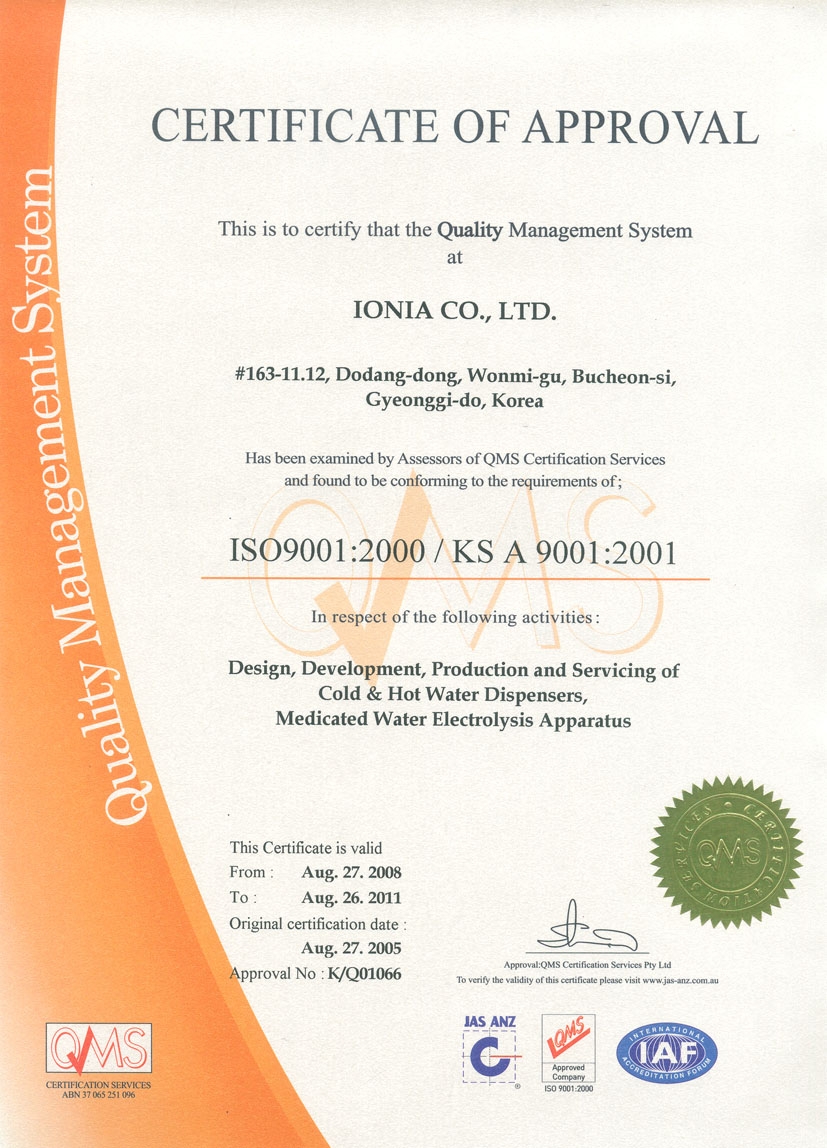
To obtain certification Jupiter was audited for:
A set of procedures that cover all key processes in the business; Monitoring processes to ensure they are effective;Keeping adequate records;Checking output for defects, with appropriate and corrective action where necessary;Regularly reviewing individual processes and the quality system itself for effectiveness; and Facilitating continual improvement.
 Ionlife executives just returned from
  www.vidaion.com
The story of alkaline water ionizers is like a river with two major streams feeding into it. The first stream is the inspirational paradigm, the idea that has led so many on a quest for a superior form of water. The second stream is the development of the process itself, the technology of the ionization of water.

In a sense, the development of the process arrived first, before the paradigm was known to the wider world of research. It came through Michael Faraday, who invented the magneto and dynamo and was one of the great pioneers of electrical energy. One of his inventions that never achieved any practical use in his lifetime was a device for creating electrolysis, the electronic separation of water into its two principal constituents, hydrogen and oxygen. Later on, a form of electrolysis was used in the creation of the alkaline water ionizer.
It would take more than a century for scientists throughout the world to find the inspiration they needed to move forward with their quest to find perfect, healthier water for use by mankind. There were probably a wide variety of people who felt this inspiration. However, the full story of the development of the alkaline water ionizer has yet to be accurately traced.
One of those early researchers, Dr. Henri Coanda, was a renowned Rumanian scientist and Nobel Prize winner. He is known primarily for his study of fluid dynamics and its application to aeronautics. What is less known was his lifelong obsession with the structure of water, an obsession no doubt fueled by the stories of longevity that surfaced regarding the people of Hunza. As far back as the 1930’s, Coanda journeyed to that remote land to confirm his speculations that perhaps the water of Hunza had unique properties that contributed to their longevity. His conclusion was that, indeed, the water was different. When its temperature was lowered and the Hunza water assumed a crystalline, snowflake formation, it revealed a structure similar to the venal system in humans and additionally to the vascular structure in plants.
As far as the history of alkaline water ionization goes, all roads lead to Hunza of the Himalayas and to the Andes Mountains, the Shin-Chan areas of China and the Caucasus in Azerbaijan. Remote places to be sure, but places where longevity is the rule, not the exception.

Long before attempts were made to restructure water through ionization, various scientists found the Hunza water and diet to be a matter of special interest. After all, did the Hunza not have the longest lifespan in the world? Did they not bear children when they were comparatively older than their brethren in the rest of the world? Where was their cancer, their cavities, their degenerative diseases? What caused this phenomenon of health, vitality, and an overall body balance to originate and blossom in such a far away place?
The impetus of Hunza water was and is the common denominator of research into the water of longevity. And since most of the world could not recreate the unusual glacial conditions and mountainous terrain from which this water sprang, scientists looked at the structure of the water to see if it could be created. Could they recreate this special water’s high alkaline terrain? Could they simulate its active hydrogen content? Could they infuse it with this special form of hydrogen with the extra electron? Could they match its negative Redox potential? Could they take ordinary water and create this life giving water with its remarkably high colloidal mineral content?
The history of this search and that of others for a more perfect, more healing water, and the subsequent invention of the alkaline water ionizer, has perhaps yet to be told in full. Part of what is written here has been surmised from verbal accounts. The true story of this adventure has never been accurately recorded.
Although the account seems somewhat murky, it is believed that sometime after World War II, there was an attempt on the part of a number of Russian and Japanese researchers to investigate these same waters that Coanda had investigated. It is not clear exactly what inspired them to go forth, but by the 1940’s, certainly many more knew about Hunza than had known before. Its reality, in fact, had led to the romantic novel, Lost Horizons, about a mythical kingdom called Shangri-la, where people lived forever. Lost Horizon’s adaptation to film, in a blockbuster movie directed by Frank Capra, projected the story of the secret wells of life secluded in the mountainous regions of the Himalayas. By the end of the 1940’s, although no one claimed true immortality for the inhabitants of Hunza, there was a fever to find and understand the secret source of the longevity of the people of Hunza. The majority sensed that it lay in both diet and water.
The story, which has proliferated in an undeveloped form, is that the Japanese tapped into the new methods of electrolysis experiments being done by their Russian peers which had no doubt been inspired by the original technology of Faraday.
Alkaline ionic water is made by using a water ionizer to split electrically filtered tap water into alkaline ionic water and acid water, each of which then feeds into a separate chamber. One chamber contains the alkaline water that has been found to be so enriching to human health and wellness. The second chamber contains the acid water, which has remarkable uses as well.
The first water ionizer, whose technology conformed to this description, was developed in Japan in the early 50’s, probably as a result of probing into the Russian system of electrolysis. The experiments were first conducted on plants and animals. Full-scale development started in 1954 Several Japanese agricultural universities began looking into the effects of alkaline ionic water, and especially the effects of acid water on plants. Today nursery farmers that supply cut flowers use acid water to keep their flowers fresh for a longer period of time before delivery to the flower shops.
It took longer to gather data on humans, certainly a much more complex effort. However, doctors in Japan finally collected enough data to confirm not only the non-toxicity of the alkaline water, but its beneficial effects in eradicating certain disease conditions. The new methodology was called functional water technology, a term still used in Japan to this day.
The first commercial alkaline ionic water ionizers were available in Japan in l958. At first, only very large units were used in hospitals. In l960, a group of Japanese medical doctors and agricultural research scientists, formed a special medical and agricultural research institute to investigate ionized water. Annual meetings were held to report their findings. Finally, in January 1966, the Health and Rehabilitation Ministry of the Japanese Government acknowledged the alkaline ionic water ionizer as a legitimate medical device for improving human health.
Japanese-made alkaline ionic water ionizers were first introduced to Korea in the 70’s, and today are also approved as medical devices by the government of South Korea. In 1985, the Korean-made household unit was introduced in the United States. A successful toxicity test was conducted by an independent testing laboratory in LA utilizing FDA standards the next year. The results proved that there was no toxicity in the alkaline ionic water generated by the water ionizer.

Despite the success of the testing, it wasn’t until the 1990’s that the market for ionizers began, principally through Japanese and Korean companies, who are still continuing their research and development now. The advent of the millennium brings a recent resurgence and growth in the alkaline water ionization, with good reason. People are sicker than ever. For all of our modern technology, medical procedures, and prescription drug use, disease rates continue to skyrocket in the majority of developed nations. The biggest common denominator amongst these nations is the fact that almost everyone drinks “dirty water.”
Over the last forty years, it is estimated that somewhere in the neighborhood of 30 million Japanese citizens have used these devices. This could very well help explain the fact that Japan has the number one health care system in the world as reported by Dr. Barbara Starfield in the Journal of the American Medical Association (JAMA). Japan reports higher cancer survival rates and other disease recovery rates as well. Unfortunately, the United States ranked a miserable number thirteen in this report. Could a partial answer to what plagues you lie in life giving and life sustaining ionized water? We think so.
Dr. Linda Posch MS SLP ND: Has an eclectic clinical approach and strongly advocates the use of ionized water coupled with whole food liquid vitamins and whole food vitamin supplements.
 In an effort to increase dealer product knowledge,
 NEW AT IONLIFE

 Posts
All Comments
Posts
All Comments


